Institute of Science, Technology, Engineering and Medicine
To all who read this message,
I, Remi-Niyi Alaran, am sufficiently concerned about the future competitiveness of our people across Africa, to propose the following:
To set up a privately funded institute for research and development of products that directly address the educational and economic needs of the masses of our people. The focus is to be on science, technology, engineering and medicine (STEM).
The focus on STEM is intentional. This institute will aim to become an internationally competitive centre of excellence in the four research areas. To survive economically, the institute will aggressively aim to develop commercial enterprises based on its work.
Your contributions can help make this a world-standard research institute. This will assist in giving our youth a target at which to aim their ambitions for academic and enterprise progress. Hopefully, its excellence will help pull talented youth through the tattered education systems we currently witness across the continent.
A small plot of land in Western Nigeria has been donated to the institute: solutions must arise from the context of the problems we face, not from abroad. Also, a website is in progress. The Internet offers us a worldwide online forum for collaboration on the issues faced. It will be a medium for news and course content to be widely broadcast and received at relatively low cost.
This will be my life's work. As the poet Fela Anikulapo-Kuti once said: "Condition don reach make I act". Please email to iyaalata@netscape.net to establish contact if you have the expertise or experience in:
# STEM research or enterprise
# Fabrication or manufacturing of machinery
# Chemical engineering and process industries
# Linux/network computer systems administration
We can and must make this work.
Africans need to be internationally competitive in STEM research and in the enterprises based on STEM research. Our future as a people depends on our ability and willingness to shape that future through investment in ourselves and our community.
Contribute what you can, and be proud of your heritage.
Remi-Niyi Alaran
Showing posts with label technology. Show all posts
Showing posts with label technology. Show all posts
Tuesday, May 27, 2008


Bi Eshe Le Hu Kanga
How to build a water well.
The next time any African introduces themselves to you as Engineer this or Engineer that, tell the wastrel to go dig a borehole for a village or fetch water with a bucket. Are you tired of fetching water with a bucket? The Enterprising Communities series shows you how to harvest rainwater...
Africa's home grown engineers are just not worth their professional title. That is what the Nigerian government thnks when it gives estimated 94pc of all engineering works to foreign consulting firms. From bridges to stadiums, from multi-storey buildings to GSM masts, from roads to wells, no local engineering firm is deemed sufficiently capable by national or state governments. These so-called engineers should redeem themselves.
There is talk of Chinese engineers building 598 water wells in eighteen Nigerian (18, meejoola) states - including Ogun, Oyo, Akwa Ibom and Abuja. Chinese Engineers digging boreholes in Nigeria?! Whatever happened to the yearly thousands of civil, mechanical, electrical, chemical B.Eng and M.Eng produced by higher institutions in these states? WATER WELLS, haba. People in the village have been building kaanga (water well) and shalanga (pit latrine) for aeons, without importing Chinese, Irish or Gabonese to provide "technical assistance".
This is a very serious matter. There is an oncoming GLOBAL shortage of clean water. In fact, scientists are predicting that future wars over water supplies will be more intense than current conflicts over crude oil supplies! Those who live in places where drinking water appears, from a centralised waterworks, wherever you open a tap will notice that their water bills are annually increasing at above-inflation rates. So everybody can benefit from knowing how to harvest water locally, cheaply, cleanly and efficiently.
Whether you live in the city or in the village, in the rain-soaked swamp or in the drought-stricken areas can still benefit from rainwater harvesting and from runoff water harvesting.
RAINWATER HARVESTING
Requirements: corrugated roofing sheets, a filter made from a 50-litre plastic keg (optional), collector pipe (plastic), distribution pipe (plastic), and water butt The water butt can be above ground tank with a tap attached to it. Alternatively it may be below ground tank with a small handpump attached to it. Above-ground butts are easier to clean while below ground butts are better supported. Below ground butt may also be dug out tank with walls, bottom and top covered with cement/concrete.
1. Build your house with a sloping (A-style) roof design.
2, Cover the roof with strips of corrugated sheets. Make sure the bottom edge of sheets near the top cover the upper edge of the next lower sheet. Let the bottommost sheet overlap the edge of the roof.
3. Collector pipe: Cut off a section from some of your pipe so that the 0-shape becomes U-shape. Put the collector pipe along the length of your roof with the roof overhang inside the bowl of the U-shape.
4. Filter/Connector keg: Turn the keg upside down. Cut a hole in the side farthest from the sprout for insertion of the collector pipe. You may fold some clothing several times and tie to the collector pipe at its insertion point. This acts as a filter to prevent debris from the roof from entry your rainwater harvesting system. (lace curtains are excellent for this purpose). Attach the keg firmly to the side of your house. Place the bottom (capped) end of the keg over the entrance of the direction pipe. Remove the cap from the keg.
5. Direction pipe: Place one end over the end of the connector keg and place the other end OVER (not into) the top of he water butt.
6. When rain falls, let the initial rainfall flow away before inserting the directon pipe into the top of the water butt. In the heavy rainfall conditions experienced across most of sub-saharan region of Africa, you may find that a family of six can more-than-satisfy their domestic water needs from rainfall collected in this manner.
7. Rainwater is relatively pure compared to groundwater. If you regularly keep your roof and the collector pipe clear of debris, you may safely use this rainwater for washing clothes, flushing, body cleaning and other non-injested usages. It is recommended that the water be heated, and allowed to for some minutes, before drinking or cooking. Boiling kills pathogens that may be too small for you to see and yet they live in the water.
8. If an underground water butt is used, take care to ensure there are no pit latrines or sewage tanks in its vicinity. If in doubt, put the water butt on the opposite end of the house from any sewage facilities.
COMMENT: Anyone who has lived with a leaking roof will bear witness to the volumes of rainwater that can efficiently be collected with this system!
RUNOFF WATER HARVESTING
Farmers need lots of water for irrigation and animal husbandry. People in drought-stricken areas may need to walk several miles to find a water hole. Many Nigerians/Africans do not have tap-borne water in their homes. In all these cases, women and children are often tasked to walk miles in search of drinking water. They regularly carry loads of 3kg (mudu meeta) on their heads two to three times a day. Yet they live in places where rain falls heavily and runs off into gullies thereby causing severe erosion and loss of topsoil. This runoff rainwater can be harvested easily in rural areas or combined with the rainwater harvesting method discussed above.
Requirements: Cement/concrete; an open space about 2000 sq metres; water pump; wire gauze
1. Clear an area of 500sg metres in a corner of your space. Inside the clearing, dig a CIRCULAR-shape underground tank of radius 5 meters. Make it as deep as you like.
2. Cover the sides and bottom with cement blocks or concrete. The bottom should be covered. This is not a well that taps underground water. You don't want the water that you collect to drain away!
3.Make an indentation near the lip of the underground tank. This indentation may be 1.5 metres wide and about 0.5 metres below-ground-level at the inlet of the tank. So, the indentation is deepest at the inlet of the tank and becomes shallower until it reaches ground level. It will look like the pouring end of a jug. Now make 5 cement/concrete mini-slopes between the tank inlet and the "pouring" end. Each slope has a vertical face that is about 0.1 metres high. This face points away trom the tank. Cover the sides of the tanks and the indentation with cement/concrete so that it extends about 0.2metres above ground level. Now the indentation looks like the pouring end of a jug with teeth! Cover the indentation with wire gauze to prevent animals or debris from entering the tank.
4. Gradually slope the rest of the 1500sq metres towards the indentation of the tank. This is the collector funnel. Plant grass in this area, if you want to.
5. Security: Erect a small wooden fence around the tank and inlet area. Cover this fence with a thatch, wood, or corrugated iron roof. The fence and roof help prevent birds or roaming animals (including people) from falling into your tank. For additional security, erect another fence (no roof!) around the 2000sq metre area.
6. When rain falls, the collector funnel will direct it towards your underground tank. The grass, if any, will slow down the velocity of water so that it flows gently into the indentation. The grass will also filter small twigs, stones etc. The "teeth" of the indentation futher prevent small stones and other debris from entering the tank. Clean the teeth weekly during the rainy season.
7. Pump the water out. In places with clear skies and heavy rainfalls, sufficient water will collect here for farming purposes and for domestic use. Do not "fetch" water by dipping buckets, pails, etc into the water. This is to prevent contaminating the water. Invest in a handpump or buy a mechanical powered pump. You should charge a small fee for use of this waterworks in order to afford the cost of construction, operation and replacement pumps, etc. It's a business.
COMMENTS:
Static water is a breeding ground for mosquitoes. But do not poison the water by pouring kerosene or insecticide or any other chemicals in the tank to "kill the mosquitoes!". Instead consider putting a wooden or concrete slab directly over the rim of the tank to cut off air supply. The slab should have one to three grooves of 10cm diameter cut into it to allow overflow of the tank. Cover groove(s) with wire gauze. Get that person that calls themselves engineer to help you.
Some places suffer from chemically toxic rainfall e.g places with heavy flaring of gas or burning of waste. The method described in this document for harvesting rainwater will not be appropriate in such places.
Always boil water before drinking or cooking. Se omi kee to mu abi jeun.
Remi-Niyi Alaran writes on enterprise and social capital.
ALARAN DEVELOPMENT ENTERPRISES. Enterprising Communities.
Copyright (c) ALARAN DEVELOPMENT ENTERPRISES, 2003
You may copy, transmit, or otherwise use this document provided the copyright notice is attached.
It is the 1st (ikini) of the Enterprising Communities series to be published by ALARAN DEVELOPMENT ENTERRISES. This series aims to assist African enterpreneurs in building business enterprises based on innovations in science, technology, engineering and medicine.
HOW TO (NOT NEED TO) DIG A WATER WELL (KAANGA)
Introduction:
The next time any African introduces themselves to you as Engineer this or Engineer that, tell the wastrel to go dig a borehole for a village or fetch water with a bucket. Are you tired of fetching water with a bucket? The Enterprising Communities series shows you how to harvest rainwater...
Africa's home grown engineers are just not worth their professional title. That is what the Nigerian government thnks when it gives estimated 94pc of all engineering works to foreign consulting firms. From bridges to stadiums, from multi-storey buildings to GSM masts, from roads to wells, no local engineering firm is deemed sufficiently capable by national or state governments. These so-called engineers should redeem themselves.
There is talk of Chinese engineers building 598 water wells in eighteen Nigerian (18, meejoola) states - including Ogun, Oyo, Akwa Ibom and Abuja. Chinese Engineers digging boreholes in Nigeria?! Whatever happened to the yearly thousands of civil, mechanical, electrical, chemical B.Eng and M.Eng produced by higher institutions in these states? WATER WELLS, haba. People in the village have been building kaanga (water well) and shalanga (pit latrine) for aeons, without importing Chinese, Irish or Gabonese to provide "technical assistance".
This is a very serious matter. There is an oncoming GLOBAL shortage of clean water. In fact, scientists are predicting that future wars over water supplies will be more intense than current conflicts over crude oil supplies! Those who live in places where drinking water appears, from a centralised waterworks, wherever you open a tap will notice that their water bills are annually increasing at above-inflation rates. So everybody can benefit from knowing how to harvest water locally, cheaply, cleanly and efficiently.
Whether you live in the city or in the village, in the rain-soaked swamp or in the drought-stricken areas can still benefit from rainwater harvesting and from runoff water harvesting.
RAINWATER HARVESTING
Requirements: corrugated roofing sheets, a filter made from a 50-litre plastic keg (optional), collector pipe (plastic), distribution pipe (plastic), and water butt The water butt can be above ground tank with a tap attached to it. Alternatively it may be below ground tank with a small handpump attached to it. Above-ground butts are easier to clean while below ground butts are better supported. Below ground butt may also be dug out tank with walls, bottom and top covered with cement/concrete.
1. Build your house with a sloping (A-style) roof design.
2, Cover the roof with strips of corrugated sheets. Make sure the bottom edge of sheets near the top cover the upper edge of the next lower sheet. Let the bottommost sheet overlap the edge of the roof.
3. Collector pipe: Cut off a section from some of your pipe so that the 0-shape becomes U-shape. Put the collector pipe along the length of your roof with the roof overhang inside the bowl of the U-shape.
4. Filter/Connector keg: Turn the keg upside down. Cut a hole in the side farthest from the sprout for insertion of the collector pipe. You may fold some clothing several times and tie to the collector pipe at its insertion point. This acts as a filter to prevent debris from the roof from entry your rainwater harvesting system. (lace curtains are excellent for this purpose). Attach the keg firmly to the side of your house. Place the bottom (capped) end of the keg over the entrance of the direction pipe. Remove the cap from the keg.
5. Direction pipe: Place one end over the end of the connector keg and place the other end OVER (not into) the top of he water butt.
6. When rain falls, let the initial rainfall flow away before inserting the directon pipe into the top of the water butt. In the heavy rainfall conditions experienced across most of sub-saharan region of Africa, you may find that a family of six can more-than-satisfy their domestic water needs from rainfall collected in this manner.
7. Rainwater is relatively pure compared to groundwater. If you regularly keep your roof and the collector pipe clear of debris, you may safely use this rainwater for washing clothes, flushing, body cleaning and other non-injested usages. It is recommended that the water be heated, and allowed to for some minutes, before drinking or cooking. Boiling kills pathogens that may be too small for you to see and yet they live in the water.
8. If an underground water butt is used, take care to ensure there are no pit latrines or sewage tanks in its vicinity. If in doubt, put the water butt on the opposite end of the house from any sewage facilities.
COMMENT: Anyone who has lived with a leaking roof will bear witness to the volumes of rainwater that can efficiently be collected with this system!
RUNOFF WATER HARVESTING
Farmers need lots of water for irrigation and animal husbandry. People in drought-stricken areas may need to walk several miles to find a water hole. Many Nigerians/Africans do not have tap-borne water in their homes. In all these cases, women and children are often tasked to walk miles in search of drinking water. They regularly carry loads of 3kg (mudu meeta) on their heads two to three times a day. Yet they live in places where rain falls heavily and runs off into gullies thereby causing severe erosion and loss of topsoil. This runoff rainwater can be harvested easily in rural areas or combined with the rainwater harvesting method discussed above.
Requirements: Cement/concrete; an open space about 2000 sq metres; water pump; wire gauze
1. Clear an area of 500sg metres in a corner of your space. Inside the clearing, dig a CIRCULAR-shape underground tank of radius 5 meters. Make it as deep as you like.
2. Cover the sides and bottom with cement blocks or concrete. The bottom should be covered. This is not a well that taps underground water. You don't want the water that you collect to drain away!
3.Make an indentation near the lip of the underground tank. This indentation may be 1.5 metres wide and about 0.5 metres below-ground-level at the inlet of the tank. So, the indentation is deepest at the inlet of the tank and becomes shallower until it reaches ground level. It will look like the pouring end of a jug. Now make 5 cement/concrete mini-slopes between the tank inlet and the "pouring" end. Each slope has a vertical face that is about 0.1 metres high. This face points away trom the tank. Cover the sides of the tanks and the indentation with cement/concrete so that it extends about 0.2metres above ground level. Now the indentation looks like the pouring end of a jug with teeth! Cover the indentation with wire gauze to prevent animals or debris from entering the tank.
4. Gradually slope the rest of the 1500sq metres towards the indentation of the tank. This is the collector funnel. Plant grass in this area, if you want to.
5. Security: Erect a small wooden fence around the tank and inlet area. Cover this fence with a thatch, wood, or corrugated iron roof. The fence and roof help prevent birds or roaming animals (including people) from falling into your tank. For additional security, erect another fence (no roof!) around the 2000sq metre area.
6. When rain falls, the collector funnel will direct it towards your underground tank. The grass, if any, will slow down the velocity of water so that it flows gently into the indentation. The grass will also filter small twigs, stones etc. The "teeth" of the indentation futher prevent small stones and other debris from entering the tank. Clean the teeth weekly during the rainy season.
7. Pump the water out. In places with clear skies and heavy rainfalls, sufficient water will collect here for farming purposes and for domestic use. Do not "fetch" water by dipping buckets, pails, etc into the water. This is to prevent contaminating the water. Invest in a handpump or buy a mechanical powered pump. You should charge a small fee for use of this waterworks in order to afford the cost of construction, operation and replacement pumps, etc. It's a business.
COMMENTS:
Static water is a breeding ground for mosquitoes. But do not poison the water by pouring kerosene or insecticide or any other chemicals in the tank to "kill the mosquitoes!". Instead consider putting a wooden or concrete slab directly over the rim of the tank to cut off air supply. The slab should have one to three grooves of 10cm diameter cut into it to allow overflow of the tank. Cover groove(s) with wire gauze. Get that person that calls themselves engineer to help you.
Some places suffer from chemically toxic rainfall e.g places with heavy flaring of gas or burning of waste. The method described in this document for harvesting rainwater will not be appropriate in such places.
Always boil water before drinking or cooking. Se omi kee to mu abi jeun.
Remi-Niyi Alaran writes on enterprise and social capital.
ALARAN DEVELOPMENT ENTERPRISES. Enterprising Communities.
Copyright (c) ALARAN DEVELOPMENT ENTERPRISES, 2003
You may copy, transmit, or otherwise use this document provided the copyright notice is attached.
Agbe Ni Arin Ilu.
This is the 4th (ikeerin) of the Enterprising Communities series to be published by ALARAN DEVELOPMENT ENTERRISES. This series aims to assist African enterpreneurs in building business enterprises based on innovations in science, technology, engineering and medicine.--------
WITH A LITTLE LATERAL THINKING, CITY DWELLERS CAN PROFIT FROM TRADING HOME
Introduction:
The population of many countries are very skewed towards residency in urban areas. Many who migrate retain some familial linkages with their rural origins. Those links can be made into profitable trade links.
Article:
Reading:
http://www.jacaranda.suite.dk/Micro-enterprises.htm
Remi-Niyi Alaran writes on enterprise and social capital.
ALARAN DEVELOPMENT ENTERPRISES. Enterprising Communities.
Copyright (c) ALARAN DEVELOPMENT ENTERPRISES, 2005
You may copy, transmit, or otherwise use this document provided the copyright notice is attached
WITH A LITTLE LATERAL THINKING, CITY DWELLERS CAN PROFIT FROM TRADING HOME
Introduction:
The population of many countries are very skewed towards residency in urban areas. Many who migrate retain some familial linkages with their rural origins. Those links can be made into profitable trade links.
Article:
Reading:
http://www.jacaranda.suite.dk/Micro-enterprises.htm
Remi-Niyi Alaran writes on enterprise and social capital.
ALARAN DEVELOPMENT ENTERPRISES. Enterprising Communities.
Copyright (c) ALARAN DEVELOPMENT ENTERPRISES, 2005
You may copy, transmit, or otherwise use this document provided the copyright notice is attached
Ise Wa Fun Akole
Engineering Construction opportunities
ALARAN
Alaran Development Enterprises [Alaran] is a development services organisation that aims to build manufacturing capabilities and infrastructure across Africa. Atunlushe is our engineering construction business, based in Ogun, Nigeria with divisions in Utilities, Construction, Logistics, and Services. Atunlushe is tendering in 2005 to develop on build-own-operate basis in western Nigeria: a multi-activity centre, a heritage resort, and a science park with extensive facilities for location of knowledge based businesses. These developments are complemented with dedicated utilities, logistic services, and residential housing.
Atunlushe seeks suppliers to provide commodities and services under agreement. Suppliers must have full-time management who have gained relevant qualifications and proven work experience in engineering, computing and construction projects. Suppliers are encouraged to undertake continous professional training in engineering, scientific, construction and project management disciplines, and to provide opportunities for placement of young people into apprenticeships. In return, suppliers enjoy preferential trade access as well as capital funding, profit-share, and risk management.
Remi-Niyi Alaran
Ijebu-Ode, Ogun , West Africa. July 2005
(c) Copyright Alaran Development Enterprises 2005
ALARAN
Alaran Development Enterprises [Alaran] is a development services organisation that aims to build manufacturing capabilities and infrastructure across Africa. Atunlushe is our engineering construction business, based in Ogun, Nigeria with divisions in Utilities, Construction, Logistics, and Services. Atunlushe is tendering in 2005 to develop on build-own-operate basis in western Nigeria: a multi-activity centre, a heritage resort, and a science park with extensive facilities for location of knowledge based businesses. These developments are complemented with dedicated utilities, logistic services, and residential housing.
Atunlushe seeks suppliers to provide commodities and services under agreement. Suppliers must have full-time management who have gained relevant qualifications and proven work experience in engineering, computing and construction projects. Suppliers are encouraged to undertake continous professional training in engineering, scientific, construction and project management disciplines, and to provide opportunities for placement of young people into apprenticeships. In return, suppliers enjoy preferential trade access as well as capital funding, profit-share, and risk management.
Remi-Niyi Alaran
Ijebu-Ode, Ogun , West Africa. July 2005
(c) Copyright Alaran Development Enterprises 2005
Monday, February 04, 2008
Virtualisation with Ubuntu Server
How to Develop Virtual Appliances Using Ubuntu JeOS
Must look at using virtualisation to get soft-appliances in widespread use across Afrika. The technology promises to lower the cost of building hardware data-centres.
Would this work on Debian, or does it require have proprietary Ubuntu dependencies?
Must look at using virtualisation to get soft-appliances in widespread use across Afrika. The technology promises to lower the cost of building hardware data-centres.
Would this work on Debian, or does it require have proprietary Ubuntu dependencies?
Monday, September 24, 2007
Rations
Many countries of Africa keep their foreign reserves, and conduct their international trade in the USA currency, the dollar. There are indications that the economy of that country is in deep trouble and that its currency may be severely depreciated. Consider this statement to the USA Congress arm of government.
What would happen to your dollar-ised money if the USA goes into depression?
The value of your wealth will be much reduced. You may be unable to get cash out of the banks. The price of everyday consumables will go up very sharply. These events will trigger a massive transfer of wealth from you to those who sell the things you want to buy.
First, prepare your family, now, by stocking up on some essentials:

Dried / smoked fish or Cans of Fish
Bags of Nuts especially Groundnut due to high protein content
Bags of Rice
Red Palm Oil (it is very stable at room temperature)
Bags of Dehydrated fruits put them in a glass jar, cover with nylon and screw down the lid)
Boxes of Cereals like Coco pops which you can eat straight out the box
Batteries
Radios (preferably wind up)
Matches/lighters
Candles
Torches (preferably wind up)
Hot water bottles
Wood
Paper
Pens and Pencils
Soaps
Washing powders
Washing up liquids
Toilet Paper
Blankets
Fire Kettles
Bottled fuel
Bottled Stoves
Medications/Herbs/supplements
Toothpaste
Camping burners/stoves & spare gas bottles
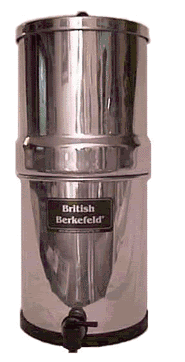
Bottled Water (try to get a British Berkefield "gravity water filter" system)
Second, Secure your water supply
Make Your Own Water Filter: Using What's Available Is All It Takes
By Tony Cunningham
It is possible to make your own water filter and turn dirty and contaminated water into clean and pure drinking water by sending the water through many layers that help in filtering out the contained impurities and such a system is much like what tap water goes through at a treatment station.
A Couple Of Simple Methods
You do not need much to make your own water filter, and a two liter plastic pop bottle and lid, straw, cotton batting, gravel, sand, coffee filter as well as jar along with (of course) muddy water will do. You will then have to take a few steps to make your own water filter which include cutting the bottom of the pop bottle, placing into it a layer of cotton batting and layers of fine grain sand, large grain sand as well as small and large gravel, cutting the coffee filter to fit the top of the bottle, and placing this on top of the gravel. Finally, you need to pour the muddy water into the open end of the bottle and allow the water to seep down the filter layers.
Following these simple steps will allow anyone to make their own water filter. To make doubly sure that the water is properly filtered, you may add four to eight drops of chlorine to each gallon of filtered water.
There is even more sophisticated means to making your own water filter, and it is doubly important in case you only have access to dirty and muddy water which per force you need to drink. This may happen when you are out camping, or in a place where there is no filtered water available for drinking.
When you do make your own water filter, you will undoubtedly be removing just the “visible” portion of the contaminants. This is a small though good beginning, and there are a number of different and easy ways to go about the business of filtering water without needing to purchase a water filter.
All you really need is to use things that are readily available including a container that should have five to ten holes punched at the bottom. Fill the container with layers of sand and gravel from the bottom all the way to the top. Collect enough water and the pour it through the filter, and catch the ‘filtered' water in another container at the bottom. In case the water does not look clean, you may have to pour it once again, or as many times as is necessary for it to turn clear.
Third, take your USD dollars and buy a farm, well away from any "urban" areas.
Fourth, arm your self for protection and hunting. There will be many wild-life after the start of the next world war.
What would happen to your dollar-ised money if the USA goes into depression?
The value of your wealth will be much reduced. You may be unable to get cash out of the banks. The price of everyday consumables will go up very sharply. These events will trigger a massive transfer of wealth from you to those who sell the things you want to buy.
First, prepare your family, now, by stocking up on some essentials:
Dried / smoked fish or Cans of Fish
Bags of Nuts especially Groundnut due to high protein content
Bags of Rice
Red Palm Oil (it is very stable at room temperature)
Bags of Dehydrated fruits put them in a glass jar, cover with nylon and screw down the lid)
Boxes of Cereals like Coco pops which you can eat straight out the box
Batteries
Radios (preferably wind up)
Matches/lighters
Candles
Torches (preferably wind up)
Hot water bottles
Wood
Paper
Pens and Pencils
Soaps
Washing powders
Washing up liquids
Toilet Paper
Blankets
Fire Kettles
Bottled fuel
Bottled Stoves
Medications/Herbs/supplements
Toothpaste
Camping burners/stoves & spare gas bottles
Bottled Water (try to get a British Berkefield "gravity water filter" system)
Second, Secure your water supply
Make Your Own Water Filter: Using What's Available Is All It Takes
By Tony Cunningham
It is possible to make your own water filter and turn dirty and contaminated water into clean and pure drinking water by sending the water through many layers that help in filtering out the contained impurities and such a system is much like what tap water goes through at a treatment station.
A Couple Of Simple Methods
You do not need much to make your own water filter, and a two liter plastic pop bottle and lid, straw, cotton batting, gravel, sand, coffee filter as well as jar along with (of course) muddy water will do. You will then have to take a few steps to make your own water filter which include cutting the bottom of the pop bottle, placing into it a layer of cotton batting and layers of fine grain sand, large grain sand as well as small and large gravel, cutting the coffee filter to fit the top of the bottle, and placing this on top of the gravel. Finally, you need to pour the muddy water into the open end of the bottle and allow the water to seep down the filter layers.
Following these simple steps will allow anyone to make their own water filter. To make doubly sure that the water is properly filtered, you may add four to eight drops of chlorine to each gallon of filtered water.
There is even more sophisticated means to making your own water filter, and it is doubly important in case you only have access to dirty and muddy water which per force you need to drink. This may happen when you are out camping, or in a place where there is no filtered water available for drinking.
When you do make your own water filter, you will undoubtedly be removing just the “visible” portion of the contaminants. This is a small though good beginning, and there are a number of different and easy ways to go about the business of filtering water without needing to purchase a water filter.
All you really need is to use things that are readily available including a container that should have five to ten holes punched at the bottom. Fill the container with layers of sand and gravel from the bottom all the way to the top. Collect enough water and the pour it through the filter, and catch the ‘filtered' water in another container at the bottom. In case the water does not look clean, you may have to pour it once again, or as many times as is necessary for it to turn clear.
Third, take your USD dollars and buy a farm, well away from any "urban" areas.
Fourth, arm your self for protection and hunting. There will be many wild-life after the start of the next world war.
Wednesday, September 19, 2007
When is a Zulu Not a Zulu?
There is a storm brewing.
video: What Can DNA Tell Us About Race,
One of the leading authorities on race and science, Troy Duster discusses how the understanding of race is being reshaped by the genomics revolution. Sometimes unintentionally and sometimes not so innocently, genomics may be generating a new and more sophisticated racism, not so different from the eugenics-based and criminological racism that flourished in decades gone by.
Troy Duster bursts the balloon underpinning the Ancestry By DNA business.
DNA Print Genomics, a very well funded private research institute "helps police" to use DNA to catch a suspect implicated in a murder case. The case had been unsolved for years. The research institute happened to have a side business that claims it trace DNA back ten generations (about 300 years). The purpose? to help those who want to know where they are from, originally. This kind of search is particularly poignant for the African diaspora who endured separation and disconnect during the Middle Passage. The European slave trade was good business from the 1400s to about 1850 and it appears to be a perennial money spinner. There are plenty of customers. Ancestry.com report USD140 million revenues for FY2005 mostly by annual subscriptions.
Turns out that HUGO lets your ancestry be traced on both sides of parentage. You could always trace your REAL father via the Y chromosomes. Now, with genetic engineering, you can trace your real mother through mitochondrial DNA [mDNA]. Ability to trace ancestry via mother is especially important in societies where women have been raped, yet denied, for generations. Many African-Americans have some yurugu blood originating from this crime. They are not trying to disprove yurugu genes. The desire is to connect with the African heritage. Or to establish how many drops of blood... not.
Step up, Oprah Winfrey, who just knows and feels that she is Zulu. Now she has enough money to set up a research facility in Africa to enable the heritage to gain technological capabilities in genomics and biotechnology. And "Skip" Gates who may not have as much wealth, but keeps the wolf off the door by sending other (black) sheep out. And TD Jakes who fleeces them and plucks out their eyes on the way out, amen. Skip wants to know if DNAprints can help. Surprise, surprise, they "confirm" that Oprah is not Zulu after all. Seems that Oprah or Skip could not gather the strength to ask if Oprah is of the Yoruba or Ibo or any other Bantu nation. Seems they could tell all Africans had disowned Gates and Jakes.
How can you say someone is not a Zulu when you cannot sample the DNA of Zulus in the 1500s? Indeed, the only job of the Human Genome Project (HUGO) is to enable eugenicists to make racist supremacy statements while withholding the technology that allows their claims to be independently proven. It is a genocidal weapon, not a solution.
video: What Can DNA Tell Us About Race,
One of the leading authorities on race and science, Troy Duster discusses how the understanding of race is being reshaped by the genomics revolution. Sometimes unintentionally and sometimes not so innocently, genomics may be generating a new and more sophisticated racism, not so different from the eugenics-based and criminological racism that flourished in decades gone by.
Troy Duster bursts the balloon underpinning the Ancestry By DNA business.
DNA Print Genomics, a very well funded private research institute "helps police" to use DNA to catch a suspect implicated in a murder case. The case had been unsolved for years. The research institute happened to have a side business that claims it trace DNA back ten generations (about 300 years). The purpose? to help those who want to know where they are from, originally. This kind of search is particularly poignant for the African diaspora who endured separation and disconnect during the Middle Passage. The European slave trade was good business from the 1400s to about 1850 and it appears to be a perennial money spinner. There are plenty of customers. Ancestry.com report USD140 million revenues for FY2005 mostly by annual subscriptions.
Turns out that HUGO lets your ancestry be traced on both sides of parentage. You could always trace your REAL father via the Y chromosomes. Now, with genetic engineering, you can trace your real mother through mitochondrial DNA [mDNA]. Ability to trace ancestry via mother is especially important in societies where women have been raped, yet denied, for generations. Many African-Americans have some yurugu blood originating from this crime. They are not trying to disprove yurugu genes. The desire is to connect with the African heritage. Or to establish how many drops of blood... not.
Step up, Oprah Winfrey, who just knows and feels that she is Zulu. Now she has enough money to set up a research facility in Africa to enable the heritage to gain technological capabilities in genomics and biotechnology. And "Skip" Gates who may not have as much wealth, but keeps the wolf off the door by sending other (black) sheep out. And TD Jakes who fleeces them and plucks out their eyes on the way out, amen. Skip wants to know if DNAprints can help. Surprise, surprise, they "confirm" that Oprah is not Zulu after all. Seems that Oprah or Skip could not gather the strength to ask if Oprah is of the Yoruba or Ibo or any other Bantu nation. Seems they could tell all Africans had disowned Gates and Jakes.
How can you say someone is not a Zulu when you cannot sample the DNA of Zulus in the 1500s? Indeed, the only job of the Human Genome Project (HUGO) is to enable eugenicists to make racist supremacy statements while withholding the technology that allows their claims to be independently proven. It is a genocidal weapon, not a solution.
Monday, September 17, 2007
The new Eugenics
Eugenics originated in England, UK. It came to fruition as government policy in USA. It came to prominence in Germany. After disrepute under the Nazi party, eugenics became genetics and precipitated the Human Genome Project. Now it is called bio-technology. Eugenics is the foundation of the new science of Trans-genics whereby new life-forms are created by combining the genetic material of different organisms. Goats that produce milk in form of spider silk. Pigs that produce organs that beat human natural antigen defense mechanisms. Mice that have human ears growing out of their backs. A key area of intensive research is trans-humanism. Trans-humans are human beings borne of artificially combined genes. Selected human genes pre-screened to include traits deemed desirable or to exclude traits deemed undesirable. Who decides what traits will be deemed desirable or non-desirable?
Under USA chattel slavery, elite plantation owners used nearly-wageless slave labour to build wealth and power. As slave labour was nearly free, the elites had little or no use for poor "freemen" labourers. Elites tried to convince themselves and others, including slaves, that slaves were mindless sub-humans capable only of work, sex, fighting and feeding. Freemen and rebellious slaves united in many uprisings to overcome the exploitation they endured. Elites created the social concept of racism in order to divide the union among poor workers. They persecuted and drove freemen away from settled lands in order to deny them collaboration with conquered slaves. Slave-capitalism was more cost-effective than industrial-capitalism that was only beginning to establish in north-east USA. As the European settlements went west with expansion of the frontier, so did slave-capitalism threaten to undermine both free labour and industrial capital. The USA civil war was fought to stop the westward expansion of slave-capitalism, and not to free the slaves.
Elite investors in trans-humans can now see a new world order, in which trans-humans bred to be either mindless and sexless work-slaves or super-powerful mindless soldier-slaves that serve super-humans. In the transition period before these "gathacans" are become sufficient, eugenic elites are working to dumb down and de-populate the rest of humanity.
Food: control of food systems through destruction of natural pollinators (birds and bees), member-only exchange trading systems for marketing and pricing of food and commodity products, biotechnology (capital intensive seed and animal reproduction, farming, processing and preservation), consolidation of supermarkets and retail food outlets, designation of arable land as wildlife conservation areas or natural parks even as human activity enforces genocide of non-cultivated species, etc
De-population: engineered climate change, un-winnable and genocidal wars that recruit disproportionately from the 'underclass', manufactured and untreated historical diseases such as AIDS, malaria, lack of planning for natural disasters, monopoly of natural resources, depletion of groundwater that causes droughts, proliferation of 'planned parenthood' and similar abortion factories, mis-education that induces self-hatred, ethnic or racial cleansing, and gang-warfare, etc
video Trans-humanism debate
How to tackle this eugenic agenda?
Under USA chattel slavery, elite plantation owners used nearly-wageless slave labour to build wealth and power. As slave labour was nearly free, the elites had little or no use for poor "freemen" labourers. Elites tried to convince themselves and others, including slaves, that slaves were mindless sub-humans capable only of work, sex, fighting and feeding. Freemen and rebellious slaves united in many uprisings to overcome the exploitation they endured. Elites created the social concept of racism in order to divide the union among poor workers. They persecuted and drove freemen away from settled lands in order to deny them collaboration with conquered slaves. Slave-capitalism was more cost-effective than industrial-capitalism that was only beginning to establish in north-east USA. As the European settlements went west with expansion of the frontier, so did slave-capitalism threaten to undermine both free labour and industrial capital. The USA civil war was fought to stop the westward expansion of slave-capitalism, and not to free the slaves.
Elite investors in trans-humans can now see a new world order, in which trans-humans bred to be either mindless and sexless work-slaves or super-powerful mindless soldier-slaves that serve super-humans. In the transition period before these "gathacans" are become sufficient, eugenic elites are working to dumb down and de-populate the rest of humanity.
Food: control of food systems through destruction of natural pollinators (birds and bees), member-only exchange trading systems for marketing and pricing of food and commodity products, biotechnology (capital intensive seed and animal reproduction, farming, processing and preservation), consolidation of supermarkets and retail food outlets, designation of arable land as wildlife conservation areas or natural parks even as human activity enforces genocide of non-cultivated species, etc
De-population: engineered climate change, un-winnable and genocidal wars that recruit disproportionately from the 'underclass', manufactured and untreated historical diseases such as AIDS, malaria, lack of planning for natural disasters, monopoly of natural resources, depletion of groundwater that causes droughts, proliferation of 'planned parenthood' and similar abortion factories, mis-education that induces self-hatred, ethnic or racial cleansing, and gang-warfare, etc
video Trans-humanism debate
How to tackle this eugenic agenda?
Tuesday, September 04, 2007
The Yoruba FaYe writing system

I would like to share a writing system that I have developed for the Yoruba language.
Called Yoruba FaYe [meaning "draw it so we can understand it"), it may also be extended to other languages. It comprises 48 characters, alphabet (38) and numerals (10). This is a smaller character set than the 26 capitals, 26 lower-case and 10 numerals in the standard English language, which uses Roman script.
The present Yoruba script was developed by the missionary Ajayi Crowther in 1836. The Ajayi script features a standard Roman script with the addition of diacritical marks to reflect Yoruba tonality and accent, So the Ajayi script is larger than the 62 characters used in English. It has proved difficult to convert Yoruba into computer machine code because of the diacritical marks. Without the diacritical marks, it is very difficult for even accomplished Yoruba linguists to efficiently read or write Yoruba.
The FaYe system does away with diacritical marks altogether. It is phonetic, so that every sound in Yoruba is now represented by a unique character. Research indicates that humans can only delineate between about 34 unique sounds. Yoruba FaYe has a 38 character alphabet and it has a natural rhythm able to accommodate the sophistication of Yoruba's complex and rich oral literature.
It is hoped that Yoruba Faye helps in considerably improving the quantity and quality of literature available to document African Literary Heritage. You can contribute to this heritage by using FaYe script to write a book.
Obtain Yoruba Faye here or here
Thursday, August 30, 2007
Afrikans in Science
Ivan Van Settima, the author of They Came Before Columbus explores his book Blacks in Science - Ancient and Modern
Christopher Columbus NEVER ONCE set foot on the American continent.
We know little about Africa because of (historians' and anthropologists') fascination with the primitive, and their habit of extrapolating, from these limited observations, books about Africa that tell us little of the quintessential African.
Africa has far less jungle than any other continent comparable with its land space.
A great many Africans are Eurocentric in thought and deed. They do not know where they are coming from, what is going on, or where they are going.
The Europeans Avery(?) and Schmidt(?) in 1978 discovered that 1500 - 2000 years ago, Africans were smelting steel in Tanzania, in a machine using a semi-conductor unknown in Europe until the 20th century. At 1800 degree Centigrade. Producing iron crystallisation process to process a fine blue of carbon steel. In a single stage which was more efficient that Europe's later 2 stage process.
Imaging the holocaust of taking some one hundred million people out of a society over three hundred years. The massive destruction of civilisations so that people can mock Africa and say "why are you so inferior and fragmented now if you used to have such fine civilisations?"
Knowledge about "black" people has become highly politicised.
Then a discovery just a few months after the Tanzanian smelter, by American researchers Lynch(?) and Robbins(?), of an astronomical observatory, a kind of African Stonehedge, in Namaratung(?) in north-west Kenya. They were able to note that that Kenyans had developed an accurate pre- (European) historic calendar in at least 300 BCE. The calender we use today is derived from the Ancient Egyptian. It was invented in 4200 BCE. Babylonians did not have a proper calendar. The astronomical observations of Egyptians helped divided the year into 12 months of 30 days each. They put 5 festival days at the end of the year.
Cheikh Anta Diop discovered a civilisation, a monastic dynasty (Tar-Seti?) in the Nile valley dated at least 2000 years before the first dynasty of ancient Egyptian. At Tar-Seti, they founded not only architectural forms, but also the falcon god Horus, the crown art-form associated with Egypt, the palace facade later used by the Egyptians, and above all, they found heiroglyphs. So the first writing in the world is not even Egyptian, rather it is Ethiopian / Sudanic.
In west Africa, around 13th century AD, about 7 centuries ago, Africans (the Dogon tribe now in Mali) were recording the star system, Sirius B, which is invisible to the naked eye. Sirius A is a bright star that all can see. The Africans also projected its orbit and projectory up to 1990 AD at the end of the 20th century AND intuited its mass. Europe's reaction: a MIT professor is said to have commented "Africans have no business knowing this kind of thing".
The first scientific evidence of the use of numbers in the world is found in the Congo, Zaire. It is known as Ishango-bone(?) and is 8000 years old. It is a simple mathematics but it is the first evidence avalable. The Yoruba mathematical system is one of the most complex and abstract in the world.
Nobody goes to the semi-primitive communities of Eastern Europe and writes of its inhabitants as indicative of all Europeans, yet that is done with Africa.
The first medical journals, the first mathematical papyrus were WRITTEN in African languages.
A lot of the Greek, ancient and modern European, scholars went to Africa to pick up knowledge and returned to Europe to be proclaimed the father of this, the father of that...
Where is the English script? Cicero said "the English are so stupid, I am not sure we can make successful slaves of them!" There were many scripts in Africa even if only a few (the literate) used them.
By the 13th AD century, Africans were already performing eye cataract surgery, ceasarean?! section surgery, used drugs for hypertension and some phycho-somatic disorders, had perfectly ground spherical lenses, made telescopes...
In modern science, more than 100 patents by African-Americans up to 1913, despite that many inventions under slavery were attributed to plantation owners or to lawyers, as slaves were not considered citizens of the USA. A patent is a contract between the government and a citizen.
I spent 4 years at the School of African and Oriental Studies (SOAS), London University doing my first degree, and never once, never once in all those years did I learn did I learn anything about any African civilisation.
Christopher Columbus NEVER ONCE set foot on the American continent.
We know little about Africa because of (historians' and anthropologists') fascination with the primitive, and their habit of extrapolating, from these limited observations, books about Africa that tell us little of the quintessential African.
Africa has far less jungle than any other continent comparable with its land space.
A great many Africans are Eurocentric in thought and deed. They do not know where they are coming from, what is going on, or where they are going.
The Europeans Avery(?) and Schmidt(?) in 1978 discovered that 1500 - 2000 years ago, Africans were smelting steel in Tanzania, in a machine using a semi-conductor unknown in Europe until the 20th century. At 1800 degree Centigrade. Producing iron crystallisation process to process a fine blue of carbon steel. In a single stage which was more efficient that Europe's later 2 stage process.
Imaging the holocaust of taking some one hundred million people out of a society over three hundred years. The massive destruction of civilisations so that people can mock Africa and say "why are you so inferior and fragmented now if you used to have such fine civilisations?"
Knowledge about "black" people has become highly politicised.
Then a discovery just a few months after the Tanzanian smelter, by American researchers Lynch(?) and Robbins(?), of an astronomical observatory, a kind of African Stonehedge, in Namaratung(?) in north-west Kenya. They were able to note that that Kenyans had developed an accurate pre- (European) historic calendar in at least 300 BCE. The calender we use today is derived from the Ancient Egyptian. It was invented in 4200 BCE. Babylonians did not have a proper calendar. The astronomical observations of Egyptians helped divided the year into 12 months of 30 days each. They put 5 festival days at the end of the year.
Cheikh Anta Diop discovered a civilisation, a monastic dynasty (Tar-Seti?) in the Nile valley dated at least 2000 years before the first dynasty of ancient Egyptian. At Tar-Seti, they founded not only architectural forms, but also the falcon god Horus, the crown art-form associated with Egypt, the palace facade later used by the Egyptians, and above all, they found heiroglyphs. So the first writing in the world is not even Egyptian, rather it is Ethiopian / Sudanic.
In west Africa, around 13th century AD, about 7 centuries ago, Africans (the Dogon tribe now in Mali) were recording the star system, Sirius B, which is invisible to the naked eye. Sirius A is a bright star that all can see. The Africans also projected its orbit and projectory up to 1990 AD at the end of the 20th century AND intuited its mass. Europe's reaction: a MIT professor is said to have commented "Africans have no business knowing this kind of thing".
The first scientific evidence of the use of numbers in the world is found in the Congo, Zaire. It is known as Ishango-bone(?) and is 8000 years old. It is a simple mathematics but it is the first evidence avalable. The Yoruba mathematical system is one of the most complex and abstract in the world.
Nobody goes to the semi-primitive communities of Eastern Europe and writes of its inhabitants as indicative of all Europeans, yet that is done with Africa.
The first medical journals, the first mathematical papyrus were WRITTEN in African languages.
A lot of the Greek, ancient and modern European, scholars went to Africa to pick up knowledge and returned to Europe to be proclaimed the father of this, the father of that...
Where is the English script? Cicero said "the English are so stupid, I am not sure we can make successful slaves of them!" There were many scripts in Africa even if only a few (the literate) used them.
By the 13th AD century, Africans were already performing eye cataract surgery, ceasarean?! section surgery, used drugs for hypertension and some phycho-somatic disorders, had perfectly ground spherical lenses, made telescopes...
In modern science, more than 100 patents by African-Americans up to 1913, despite that many inventions under slavery were attributed to plantation owners or to lawyers, as slaves were not considered citizens of the USA. A patent is a contract between the government and a citizen.
Friday, August 24, 2007
Be The Media 2: Database-driven websites
Database-driven websites with Drupal CMS and Postgresql DBMS
CMS is content management system. DBMS is data-base management system
=== Install Postgresql 8.2 ===
$ sudo aptitude install postgresql-8.2
$ sudo su postgres
## Create user and database for Drupal on Postgresql
$ createuser -D -A -P drupaluser
$ createdb -O drupaluser drupaldb
## Remove user and database for Drupal on Postgresql
$ dropuser drupaluser
$ dropdb drupaldb
## Modify the pg_hba.conf file
$ sudo nano /etc/postgresql/8.2/main/pg_hba.conf
## comment out this line
# "local" is for Unix domain socket connections only
# local all all ident sameuser
## add the following lines
# TYPE DATABASE USER IP-ADDRESS IP-MASK $
host drupaldb drupaluser 127.0.0.1 255.255.255.25$
## save the file (Ctrl + x, y) and restart the postgresql database server engine
$ sudo /etc/init.d/postgresql* restart
## Check your database connection:
$ psql -h 127.0.0.1 -p 5432 -U drupaluser -W drupaldb
Password for user drupaluser:
INSTALL DRUPAL-5.2
## install drupal dependencies
# sudo aptitude install libapache2-mod-php5 php5-imagick imagemagick php5-ldap $
## download the drupal core files
$ sudo wget http://ftp.osuosl.org/pub/drupal/files/projects/drupal-5.2.tar.gz
tar xvzf drupal-5.2.tar.gz
## you can read the install file on creating postgresql database and user (alre$
# sudo nano drupal-5.2/INSTALL.pgsql.txt
## make a folder for your drupal installation.
sudo mkdir /var/www/drupal
## make the drupal directory writeable
sudo chown -R www-data:www-data /var/www/drupal
## move your drupal files into the drupal folder
sudo mv drupal-5.2/* drupal-5.2/.htaccess /var/www/drupal
## create a /storage folder for things like files, images, etc
$ sudo mkdir /var/www/drupal/storage
## make the data storage writeable
sudo chown -R www-data:www-data /var/www/drupal/storage
## Edit the settings.php file so that drupal can know what user, password and $
sudo nano /var/www/drupal/sites/default/settings.php
* Database URL format:
$db_url = 'pgsql://username:password@localhost/databasename';
where username = drupaluser password = drupaluserpass databasename = $
## save the file (Ctrl + x, y)
## Edit the amount of memory PHP can use to run scripts. The default 8mb is no$
sudo nano /etc/php5/apache2/php.ini file
; Resource Limits ;
memory_limit = 180M
; Example lines:
;extensions=pgsql.so
## save the file (Ctrl + x, y) and restart apache
sudo /etc/init.d/apache2 restart
### In a browser, enter: http://localhost/drupal/install.php
CONFIGURATION
## File System
## If you created a /storage folder, rather than a /files folder.
change the name of File System Path from 'files' to 'storage'
## Change the Download Method from public to private
## Select 'save configuration'
## Cron
## Click on 'You can run manually'
For further configuration, please refer to:
http://drupal.org/node/260
CMS is content management system. DBMS is data-base management system
=== Install Postgresql 8.2 ===
$ sudo aptitude install postgresql-8.2
$ sudo su postgres
## Create user and database for Drupal on Postgresql
$ createuser -D -A -P drupaluser
$ createdb -O drupaluser drupaldb
## Remove user and database for Drupal on Postgresql
$ dropuser drupaluser
$ dropdb drupaldb
## Modify the pg_hba.conf file
$ sudo nano /etc/postgresql/8.2/main/pg_hba.conf
## comment out this line
# "local" is for Unix domain socket connections only
# local all all ident sameuser
## add the following lines
# TYPE DATABASE USER IP-ADDRESS IP-MASK $
host drupaldb drupaluser 127.0.0.1 255.255.255.25$
## save the file (Ctrl + x, y) and restart the postgresql database server engine
$ sudo /etc/init.d/postgresql* restart
## Check your database connection:
$ psql -h 127.0.0.1 -p 5432 -U drupaluser -W drupaldb
Password for user drupaluser:
INSTALL DRUPAL-5.2
## install drupal dependencies
# sudo aptitude install libapache2-mod-php5 php5-imagick imagemagick php5-ldap $
## download the drupal core files
$ sudo wget http://ftp.osuosl.org/pub/drupal/files/projects/drupal-5.2.tar.gz
tar xvzf drupal-5.2.tar.gz
## you can read the install file on creating postgresql database and user (alre$
# sudo nano drupal-5.2/INSTALL.pgsql.txt
## make a folder for your drupal installation.
sudo mkdir /var/www/drupal
## make the drupal directory writeable
sudo chown -R www-data:www-data /var/www/drupal
## move your drupal files into the drupal folder
sudo mv drupal-5.2/* drupal-5.2/.htaccess /var/www/drupal
## create a /storage folder for things like files, images, etc
$ sudo mkdir /var/www/drupal/storage
## make the data storage writeable
sudo chown -R www-data:www-data /var/www/drupal/storage
## Edit the settings.php file so that drupal can know what user, password and $
sudo nano /var/www/drupal/sites/default/settings.php
* Database URL format:
$db_url = 'pgsql://username:password@localhost/databasename';
where username = drupaluser password = drupaluserpass databasename = $
## save the file (Ctrl + x, y)
## Edit the amount of memory PHP can use to run scripts. The default 8mb is no$
sudo nano /etc/php5/apache2/php.ini file
; Resource Limits ;
memory_limit = 180M
; Example lines:
;extensions=pgsql.so
## save the file (Ctrl + x, y) and restart apache
sudo /etc/init.d/apache2 restart
### In a browser, enter: http://localhost/drupal/install.php
CONFIGURATION
## File System
## If you created a /storage folder, rather than a /files folder.
change the name of File System Path from 'files' to 'storage'
## Change the Download Method from public to private
## Select 'save configuration'
## Cron
## Click on 'You can run manually'
For further configuration, please refer to:
http://drupal.org/node/260
Wednesday, August 22, 2007
Securing Yourself 1
Your activities can be monitored and recorded when you use electronic media.
When you use a computer machine to access the internet, it is possible to record your keystrokes. Keystrokes are the keys that you type, and the sequence of typing, onto the keyboard. Try to ensure no gadgets are attached to the cable connecting the keyboard to the computer machine. Be aware that keystroke recording software may be installed on the local machine.
Your data input is recorded in the computer cache (short term memory) until you switch off the machine. If you upload any data onto a remote machine, the data will be saved also into the cache and the hard (long term memory) drive of the remote machine.
When you use an electronic mail (email) or web hosting service, your data is saved into the hard drives of the service provider and is replicated (copied) onto several remote machines.
When you use a computer machine to access the internet, it is possible to record your keystrokes. Keystrokes are the keys that you type, and the sequence of typing, onto the keyboard. Try to ensure no gadgets are attached to the cable connecting the keyboard to the computer machine. Be aware that keystroke recording software may be installed on the local machine.
Your data input is recorded in the computer cache (short term memory) until you switch off the machine. If you upload any data onto a remote machine, the data will be saved also into the cache and the hard (long term memory) drive of the remote machine.
When you use an electronic mail (email) or web hosting service, your data is saved into the hard drives of the service provider and is replicated (copied) onto several remote machines.
Be The Media 1: Newspaper Publishing
Be the media.
Newspaper publishing with the Campsite open source software
Step 1:Requirements:
Campware newspaper publishing software. Available, free, by download from http://www.campware.org
Operating System software. This installation uses Debian 4.0 (Etch) version of GNU-Linux
Web Server software. This installation uses the Apache 2.0 web server and PHP 5 scripting language
Database software. This installation uses Mysql 5.0 database management system (DBMS) software
Server Machine. A server machine is a high-powered computer system. This machine will need to be powered on and connected to the Internet 24/7/365, so get one with redundant power and network ports. The machine should also have minimum of 3GHz, 2GB HDD.
Root access. The root is a super-administrator of this machine. You need root access in order to correctly install and configure the Campware software.
Normal User access, Once the software is configured, create normal user accounts to edit the newspaper. You need to create accounts for editor, contributor, etc
Step 2: Dependencies:
In the terminal window, run the following command [omit the \, it only indicates the command is all on the same line]
apt-get install \
libdbd-mysql-perl apache2 libapache2-mod-php5 openssl \
libmysqlclient15-dev libmysqlclient15off zlib1g-dev \
libxml2-dev libidn11-dev libcurl3 libcurl3-dev libssl-dev \
php5-mysql mysql-client-5.0 mysql-server-5.0 mysql-common \
g++ php5-gd imagemagick libwww-curl-perl libcurl4-openssl-dev
Step 3: Additional dependencies
you should enter and remember a password for Mysql root user
Test the connection to ensure it does not allow anonymous login! Enter 'mysql'
ERROR 1045 (28000): Access denied for user 'root'@'localhost' (using password: NO)
Test the connection to ensure it allows authorised login with password. Enter 'mysql -u user -p' for local machines or 'mysql -h host -u user -p' for database hosted on remote machines. host is name of the host machine. user is the name of database user. Enter user's password at prompt.
If like me you have problems installing libcurl-devel, you may need to compile it from source.
1. Download from here
2. Unachive it using the command: run 'tar xvzf
3. Enter the curl directory and configure: run './configure' Note that the default location is "/usr/local". to change this location to your home directory, run './configure --prefix=$HOME'
4.run 'make'
5.run 'make install'
*/
Step 4: Installation:
1. Download the latest in a directory on the server.
2. Unarchive it using the command: run 'tar xzvf'
3. Enter Campsite directory: run 'cd campsite'
4. Run './install.sh', answer the install questions.
When you run the install script, you have the option of customizing certain aspects:
Select 1 to change options.
* The default apache user/group: the administration interface scripts and template will belong to the apache user/group; when creating a new instance the script will use the default values unless instructed otherwise by the user. There may be a WARNING! on apache user and group not being "apache" but should be "www-data". Change to suit yourself.
The final configuration we use are:
APACHE_USER=www-data [apache]
APACHE_GROUP=www-data [apache]
CAMPSITE_DIR=/usr/local/campsite
BIN_DIR=/usr/local/campsite/bin
SBIN_DIR=/usr/local/campsite/sbin
ETC_DIR=/usr/local/campsite/etc
WWW_DIR=/usr/local/campsite/www
WWW_COMMON_DIR=/usr/local/campsite/www-common
DEFAULT_SMTP_SERVER_ADDRESS=localhost
DEFAULT_SMTP_SERVER_PORT=25
DEFAULT_DATABASE_SERVER_ADDRESS=localhost
DEFAULT_DATABASE_SERVER_ADDRESS=localhost
PARSER configuration:
PARSER_START_PORT=2000
Resolving Common Errors
The following errors may come up:
1. Checking ADMIN_INTERFACE module dependencies...executable convert not found in /bin:/usr/bin:/usr/local/bin:/opt/bin
ImageMagic package was not installed. Please install it.
Solution: install the imagemagick package. run '# apt-get install imagemagick'
2. Installing Campsite...The base package was installed. In order for Campsite to work you must install at least one instance.
Campsite create instance utility
There were ERRORS!!!
Unable to connect to database server.
Solution:
2a. Make sure that you have installed the mysql server [we used mysql-server-5.0].
2b. Make sure to change instance base parameters in order to insert the database password.
Do you want to change the instance base parameters? (Y/N) [N]: y
- database_password: The password is needed to connect to the database server
Enter database_password value: [enter your mysql user password]
Step 5: Congratulations on successfully installing Campsite. Now to configure Apache web server.
IMPORTANT!!!
Please configure apache server BEFORE using Campsite application; make sure
the crond daemon is running; for details read the INSTALL file and follow the instructions.
edit the "campsite-vhost.conf" file and change $SERVER_NAME to name of host server machine
# nano /usr/local/campsite/etc/campsite/campsite-vhost.conf
Change to where 100.100.10.1 is your_server_address
DocumentRoot /usr/local/campsite/www/campsite/html
ScriptAlias /cgi-bin/ /usr/local/campsite/www/campsite/cgi-bin/
Change ServerName $SERVER_NAME to ServerName your_server_name
Include the file "campsite-vhost.conf" in the main apache configuration file.
Apache v2.X (examples given as if you've used default values for installation):
1) Copy "[instance_name]-vhost.conf" to /etc/apache2/sites-available:
# cp /usr/local/campsite/etc/campsite/campsite-vhost.conf /etc/apache2/sites-available/
2) Create a symlink from sites-available to sites-enabled:
# ln -s /etc/apache2/sites-available/campsite-vhost.conf /etc/apache2/sites-enabled/
3) The campsite configuration file requires the "Actions" apache module. If the file "actions.load" is not in /etc/apache2/mods-enabled, then it's not enabled.
To check, use the following command:
# ls /etc/apache2/mods-enabled
To enable it, use the following command:
# ln -s /etc/apache2/mods-available/actions.load /etc/apache2/mods-enabled/
4) Restart the web server:
# apache2ctl restart
Or:
# /etc/init.d/apache2 restart
BTW, the main Apache2 config file is at:
# nano /etc/apache2/apache2.conf
Step 6: After configuring the apache server for Campsite enter the Campsite
administration site by starting a browser and typing in the following
URL: http://[$SERVER_NAME]/admin/ or the
URL: http//[$SERVER_ADDRESS]/admin
Fill in "admin" and "admn00" user and password respectively to log in.
You should change the password as soon as possible.
Newspaper publishing with the Campsite open source software
Step 1:Requirements:
Campware newspaper publishing software. Available, free, by download from http://www.campware.org
Operating System software. This installation uses Debian 4.0 (Etch) version of GNU-Linux
Web Server software. This installation uses the Apache 2.0 web server and PHP 5 scripting language
Database software. This installation uses Mysql 5.0 database management system (DBMS) software
Server Machine. A server machine is a high-powered computer system. This machine will need to be powered on and connected to the Internet 24/7/365, so get one with redundant power and network ports. The machine should also have minimum of 3GHz, 2GB HDD.
Root access. The root is a super-administrator of this machine. You need root access in order to correctly install and configure the Campware software.
Normal User access, Once the software is configured, create normal user accounts to edit the newspaper. You need to create accounts for editor, contributor, etc
Step 2: Dependencies:
In the terminal window, run the following command [omit the \, it only indicates the command is all on the same line]
apt-get install \
libdbd-mysql-perl apache2 libapache2-mod-php5 openssl \
libmysqlclient15-dev libmysqlclient15off zlib1g-dev \
libxml2-dev libidn11-dev libcurl3 libcurl3-dev libssl-dev \
php5-mysql mysql-client-5.0 mysql-server-5.0 mysql-common \
g++ php5-gd imagemagick libwww-curl-perl libcurl4-openssl-dev
Step 3: Additional dependencies
you should enter and remember a password for Mysql root user
Test the connection to ensure it does not allow anonymous login! Enter 'mysql'
ERROR 1045 (28000): Access denied for user 'root'@'localhost' (using password: NO)
Test the connection to ensure it allows authorised login with password. Enter 'mysql -u user -p' for local machines or 'mysql -h host -u user -p' for database hosted on remote machines. host is name of the host machine. user is the name of database user. Enter user's password at prompt.
If like me you have problems installing libcurl-devel, you may need to compile it from source.
1. Download
2. Unachive it using the command: run 'tar xvzf
3. Enter the curl directory and configure: run './configure' Note that the default location is "/usr/local". to change this location to your home directory, run './configure --prefix=$HOME'
4.run 'make'
5.run 'make install'
*/
Step 4: Installation:
1. Download the latest
2. Unarchive it using the command: run 'tar xzvf
3. Enter Campsite directory: run 'cd campsite'
4. Run './install.sh', answer the install questions.
When you run the install script, you have the option of customizing certain aspects:
Select 1 to change options.
* The default apache user/group: the administration interface scripts and template will belong to the apache user/group; when creating a new instance the script will use the default values unless instructed otherwise by the user. There may be a WARNING! on apache user and group not being "apache" but should be "www-data". Change to suit yourself.
The final configuration we use are:
APACHE_USER=www-data [apache]
APACHE_GROUP=www-data [apache]
CAMPSITE_DIR=/usr/local/campsite
BIN_DIR=/usr/local/campsite/bin
SBIN_DIR=/usr/local/campsite/sbin
ETC_DIR=/usr/local/campsite/etc
WWW_DIR=/usr/local/campsite/www
WWW_COMMON_DIR=/usr/local/campsite/www-common
DEFAULT_SMTP_SERVER_ADDRESS=localhost
DEFAULT_SMTP_SERVER_PORT=25
DEFAULT_DATABASE_SERVER_ADDRESS=localhost
DEFAULT_DATABASE_SERVER_ADDRESS=localhost
PARSER configuration:
PARSER_START_PORT=2000
Resolving Common Errors
The following errors may come up:
1. Checking ADMIN_INTERFACE module dependencies...executable convert not found in /bin:/usr/bin:/usr/local/bin:/opt/bin
ImageMagic package was not installed. Please install it.
Solution: install the imagemagick package. run '# apt-get install imagemagick'
2. Installing Campsite...The base package was installed. In order for Campsite to work you must install at least one instance.
Campsite create instance utility
There were ERRORS!!!
Unable to connect to database server.
Solution:
2a. Make sure that you have installed the mysql server [we used mysql-server-5.0].
2b. Make sure to change instance base parameters in order to insert the database password.
Do you want to change the instance base parameters? (Y/N) [N]: y
- database_password: The password is needed to connect to the database server
Enter database_password value: [enter your mysql user password]
Step 5: Congratulations on successfully installing Campsite. Now to configure Apache web server.
IMPORTANT!!!
Please configure apache server BEFORE using Campsite application; make sure
the crond daemon is running; for details read the INSTALL file and follow the instructions.
edit the "campsite-vhost.conf" file and change $SERVER_NAME to name of host server machine
# nano /usr/local/campsite/etc/campsite/campsite-vhost.conf
Change
DocumentRoot /usr/local/campsite/www/campsite/html
ScriptAlias /cgi-bin/ /usr/local/campsite/www/campsite/cgi-bin/
Change ServerName $SERVER_NAME to ServerName your_server_name
Include the file "campsite-vhost.conf" in the main apache configuration file.
Apache v2.X (examples given as if you've used default values for installation):
1) Copy "[instance_name]-vhost.conf" to /etc/apache2/sites-available:
# cp /usr/local/campsite/etc/campsite/campsite-vhost.conf /etc/apache2/sites-available/
2) Create a symlink from sites-available to sites-enabled:
# ln -s /etc/apache2/sites-available/campsite-vhost.conf /etc/apache2/sites-enabled/
3) The campsite configuration file requires the "Actions" apache module. If the file "actions.load" is not in /etc/apache2/mods-enabled, then it's not enabled.
To check, use the following command:
# ls /etc/apache2/mods-enabled
To enable it, use the following command:
# ln -s /etc/apache2/mods-available/actions.load /etc/apache2/mods-enabled/
4) Restart the web server:
# apache2ctl restart
Or:
# /etc/init.d/apache2 restart
BTW, the main Apache2 config file is at:
# nano /etc/apache2/apache2.conf
Step 6: After configuring the apache server for Campsite enter the Campsite
administration site by starting a browser and typing in the following
URL: http://[$SERVER_NAME]/admin/ or the
URL: http//[$SERVER_ADDRESS]/admin
Fill in "admin" and "admn00" user and password respectively to log in.
You should change the password as soon as possible.
Subscribe to:
Posts (Atom)